Iyami, Aje, and African Female Mysteries -East
Discover the Ancient mothers wisdom and sacred knowledge
Course Summary
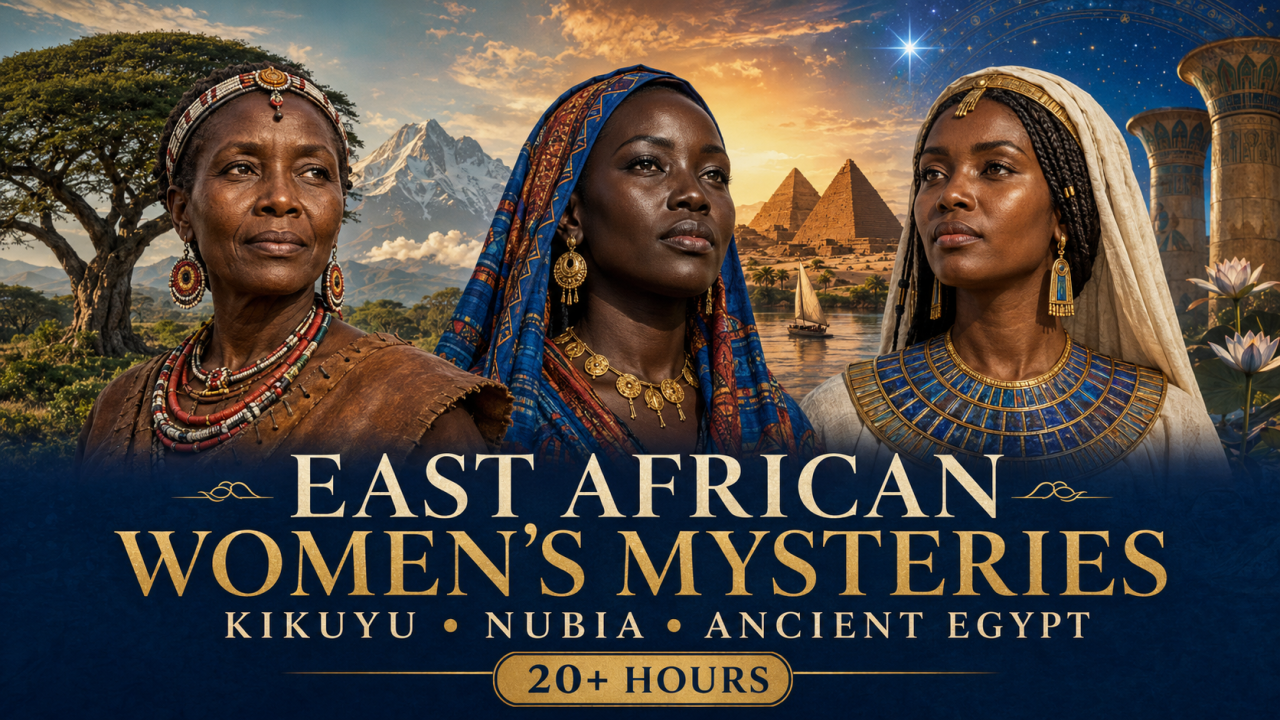
This online workshop will explore the African Women's Mysteries, a long sought East African Women’s Mysteries Auset, Ma’at and the Great Mothers of the Nile Valley First taught ten years ago, East African Women’s Mysteries remains a powerful foundation for women seeking to understand the African origins of female spiritual authority, cosmic order, queenship, healing, creation, and ancestral knowledge. The course examines some of Africa’s oldest documentable women-centered traditions, beginning in the Nile Valley and extending into the wider spiritual thought of East and Northeast Africa.\
Ancient African women were recognized as mothers, healers, rulers, temple leaders, astronomers, guardians of lineage, keepers of birth and death rites, and representatives of divine order. Their mysteries were expressed through the throne, tree, star, womb, egg, water, lioness, goose, temple, and royal arch of heaven. These symbols carried teachings about creation, power, protection, spiritual law, feminine intelligence, and the responsibility of women who held authority.
Today, many of these female powers are known primarily as “goddesses,” separated from the African cultures, cosmology, and ritual systems that gave them meaning. East African Women’s Mysteries returns these figures to their African setting and examines them as living expressions of natural law, spiritual function, royal power, motherhood, protection, healing, knowledge, and cosmic order. The course begins with the Great Mothers of the East and the African foundations of women’s mystery traditions.
You will study the African Tree of Life and the female principles connected with birth, regeneration, lineage, death, renewal, and the continuity of existence. The lessons examine how the Mother was understood as the root, container, and organizing intelligence of life. Special attention is given to the threefold mysteries of the Throne of Auset. Auset is studied as mother, queen, healer, protector, keeper of royal authority, and possessor of spiritual knowledge. Her throne symbolism opens a wider discussion of female leadership, legitimacy, inheritance, spiritual intelligence, and the power through which rulership is established and maintained.
The course also examines the mysteries of Sekhmet and Het-Heru, also known as Hathor. Through these female powers, students consider protection, healing, righteous force, joy, sexuality, motherhood, beauty, music, solar authority, and the regulation of destructive power. These teachings show how the African Mother may nurture life, defend order, correct imbalance, and restore what has been damaged.
The Royal Arch of Heaven introduces the feminine power that surrounds, contains, and gives birth to the visible world. Students examine the symbolism of the heavens as a mothering body and the relationship between celestial order, the female body, birth, time, death, and renewal. The lessons on Sati, also known as Satet, and the Path of Sirius explore water, fertility, celestial timing, spiritual direction, and the relationship between the star Sirius and the renewal of the Nile. This section helps students understand how African women’s mysteries were connected with astronomy, seasonal cycles, agriculture, kingship, and the preservation of life.
Through the mysteries of Ma’at, the course studies cosmic order, truth, balance, proper conduct, justice, reciprocity, and the responsibilities that accompany power. Ma’at is presented as an active governing principle that shapes the individual, family, community, leadership, ritual practice, and the order of the universe.
The course then enters the mysteries of the inner temple and Seshat, examining women’s relationship with knowledge, writing, measurement, memory, architecture, timekeeping, recordkeeping, and spiritual intelligence. Students consider the temple as both a physical institution and an inward place of discipline, learning, preparation, and communion.
The mystery of the Goose and the Golden Egg brings the course back to creation, gestation, potential, birth, and the original source from which life emerges. The egg becomes a teaching symbol for the unseen possibility held within the Mother before it takes visible form.
This is Feminine Mysteries I in Ori Institute’s African Women’s Mysteries series. It establishes the earlier historical and cosmological foundation for the West African Women’s Mysteries course, where the study continues through Ìyáàmi Àjẹ́, Odù, female Àṣẹ, Mami Wata, the Cosmic Calabash, women’s body gateways, and the blood mysteries. T
he East African course may be taken independently, while the complete bundle provides the fullest study across both courses.
The course contains over 20 hours of original lecture instruction, including PowerPoint presentations and additional supplemental videos. Students also receive selected ebooks, articles, research materials, and links for continued study. The recordings come from the original live class and preserve the fuller teaching, explanation, and discussion of each subject.
The program is taught by Oloye Ayele Kumari, PhD, an initiated Ìyánífá, Ìyálórìṣà, Oníṣègùn, author, professor, historian, and traditional healer with decades of study, training, priestly experience, and teaching. The course joins historical research, African cosmology, women’s spiritual knowledge, and the perspective of an initiated African woman. This course is designed for women studying African women’s history, Nile Valley traditions, Auset, Ma’at, Sekhmet, Het-Heru, Seshat, African healing, women’s priesthood, female spiritual leadership, ancestral traditions, or African feminine cosmology. It is also suitable for women who want to understand the older African foundations that shaped later women’s and men’s mystery institutions. Enrollment is reserved for biological women. Government-issued identification is required to verify eligibility before course access is granted.
- Great Mothers of the East
- The Goddess tree of life
- The trifold mysteries of the Throne of Auset
- Ms. Stories of the Goddess
- Mysteries of Sekhmet and Hether
- Mysteries of the Royal Arch of Heaven
- Mysteries of Sati and the Path of Sirius
- Mysteries of Cosmic Order and Maat
- Mysteries the Inner temple and Seshat
- Mysteries of The Goose and the Golden Egg
Course Curriculum

Chief Abiye Ayele Kumari
Professional Bio
Website: Personal Website
Chief Dr. Ayele Kumari
A Spiritual Revolutionary and Cultural Trailblazer in the Ifa Orisa tradition
Oloye Dr. Ayele Kumari, also known as Chief Yele, is a pioneering force in African spiritual traditions, breaking barriers for women and advancing Isese Ifa Orisa devotion worldwide. A fully initiated and licensed Iyanifa, professor, Onisegun (traditional healer), and artist, she has dedicated over 30 years to mastering her craft and reclaiming ancestral wisdom for future generations.
Dr Kumari began as naturopath, lay healer. and bone diviner studying with numerous teachers and healers beginning with her grandmother. She expanded those natural skills in western education to become a professor and college director. Her world was shattered after a mysterious illness left her unable to walk. This disability moved her to become initiated to Ifa which led to her healing and walking again. She began to study under elder priests to become a priestess herself. Her rise to prominence came with her groundbreaking book, Iyanifa: Women of Wisdom, which shattered stereotypes that only recognized men Babalawo as Ifa priests. While she did not create the term “Iyanifa,” her book made it more widely known and respected, empowering women to embrace their spiritual inheritance. In her plight for African Womens Mysteries, she discovered that many women actually feared honoring their mothers’ traditions, even hesitating to say “Iyami” aloud due to deep-rooted stigmas. Recognizing the lack of accessible African spiritual teachings, she founded Ori Institute, an online school dedicated to preserving and teaching ancestral wisdom. Through her transformative 40-hour course on African Women’s Mysteries, she demystified the divine feminine in African spirituality, offering clarity and empowerment to countless seekers.
In 2018, after the passing of her mother, Chief Yele stepped into a new role as a spiritual matriarch, co founding Ashe Soul Global Village, a full-service Ifa Orisa temple and spiritual community.
Understanding the challenges faced by those new to African spirituality, she authored Isese Spirituality Workbook for beginners. She followed by Hand of Ifa for dedicated Ifa practitioners. To further support the community, she published Book of Odu, providing an affordable compilation of sacred verses for deeper study.
The widespread popularity of her book, her dedication to the teaching of Isese along with her support of schools in Nigeria earned her recognition and she was conferred chieftaincy titles in Ibadan as Iya Mode United States, Otun Amunifawuni, Iya Abiye Ogboni, and Oba Olokun Omilere.
A proud African American woman, Dr. Kumari grew up immersed in the soul-stirring sounds of gospel, R&B, and classic soul. Struggling to connect with practitioners Ayele Ifa music, she sought to bridge the gap by blending African spiritual chants with the music of her roots. This creative fusion led to the birth of Ashe Soul Music, a genre of Afrospiritual music that blends ancestral wisdom with contemporary soul, offering a transformative sound that heals the heart and soothes the ancestral soul.
Through her scholarship, spiritual leadership, and musical innovation, Dr. Ayele Kumari continues to inspire, educate, and uplift those on the path of ancestral reclamation and spiritual enlightenment.